Nura × Retail Intelligence
Turning real-time skin, behavior,and product signals into store-level insights
Role
Founder, Designer, Engineer
Timeline
September 2025 – Present
Team
Solo project
The Problem
Retail teams struggle to understand what's really happening inside their stores. Skin scanners and consultants only capture surface-level signals, dashboards are fragmented across tools, and product performance varies by location with little context. As a result, teams make decisions based on gut feeling instead of data, leading to missed trends, inconsistent insights, and low visibility into what drives conversion.
The Opportunity
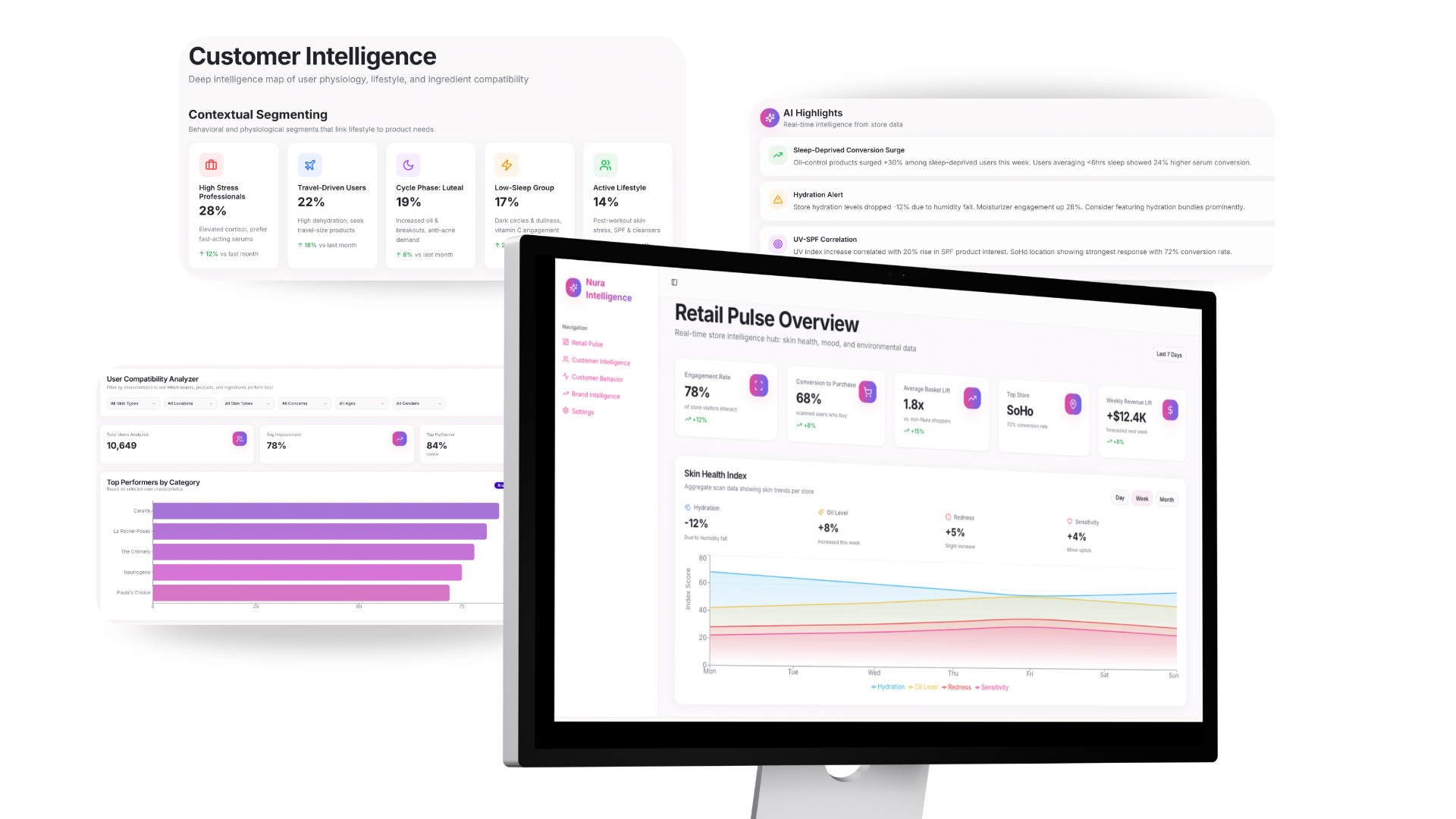
Build an AI-powered retail intelligence platform that unifies skin metrics, user behavior, environmental factors, and product performance into one real-time system. This creates a data-driven, store-aware view of customer needs, enabling teams to act faster, spot emerging trends, and deliver smarter, more consistent retail decisions across locations.
My Role
Defined the dashboard's structure, modules, and decision points, ensuring the platform supported real retail workflows and business objectives.
Designed the data model, integrated multi-source signals, and created logic for segmentation, highlight generation, and insight surfacing.
Built an interface optimized for speed and clarity, prototyped interactions for exploration and comparison, and refined visualizations for retail teams without data expertise.
The Solution
An AI-powered retail intelligence system that:
Analyzes real-time skin metrics, user behavior, and environmental signals
Unifies multi-store data into a single insights dashboard
Surfaces customer segments, trends, and conversion drivers automatically
Highlights product performance and compatibility patterns across locations
Empowers retail teams to make data-driven decisions instantly
Learnings
What I took away
Insights must be interpretable to be actionable.
I learned that data only becomes valuable when teams can understand it instantly. Designing for clarity, hierarchy, and narrative was essential to making this dashboard work for people with no analytical background.
Intelligence emerges from connecting the signals.
The most powerful insights came from combining skin metrics with environmental changes, behavior patterns, and product outcomes. Thinking in systems, and designing for those connections, was key to creating true retail intelligence.