Giving Connection × ML Intelligent Matching
Matching people to the right nonprofitsthrough ML-powered understanding
Role
SWE / Product Intern
Timeline
June 2025 – August 2025
Team
Solo project
The Problem
Finding the right nonprofit is confusing. Users face long lists, unclear categories, and inconsistent descriptions. Many people give up before they reach the help they need. At the same time, nonprofits struggle to reach the right people due to poor discovery, low visibility, and mismatched search terms. The result: friction for users, low conversion for nonprofits, and inefficient support pathways.
The Opportunity
Build an ML-powered matching engine that transforms a user's branching-quiz responses into semantic vectors, enabling personalized nonprofit recommendations with clearer discovery and dramatically lower friction. This system would help users articulate needs, reduce overwhelm, and improve match accuracy.
My Role
Scoped the user journey, defined matching requirements, and shaped the branching-quiz workflow that feeds the ML engine.
Researched models, wrote the code for semantic-vector generation and matching logic, tested embeddings, and validated outputs with real nonprofit data.
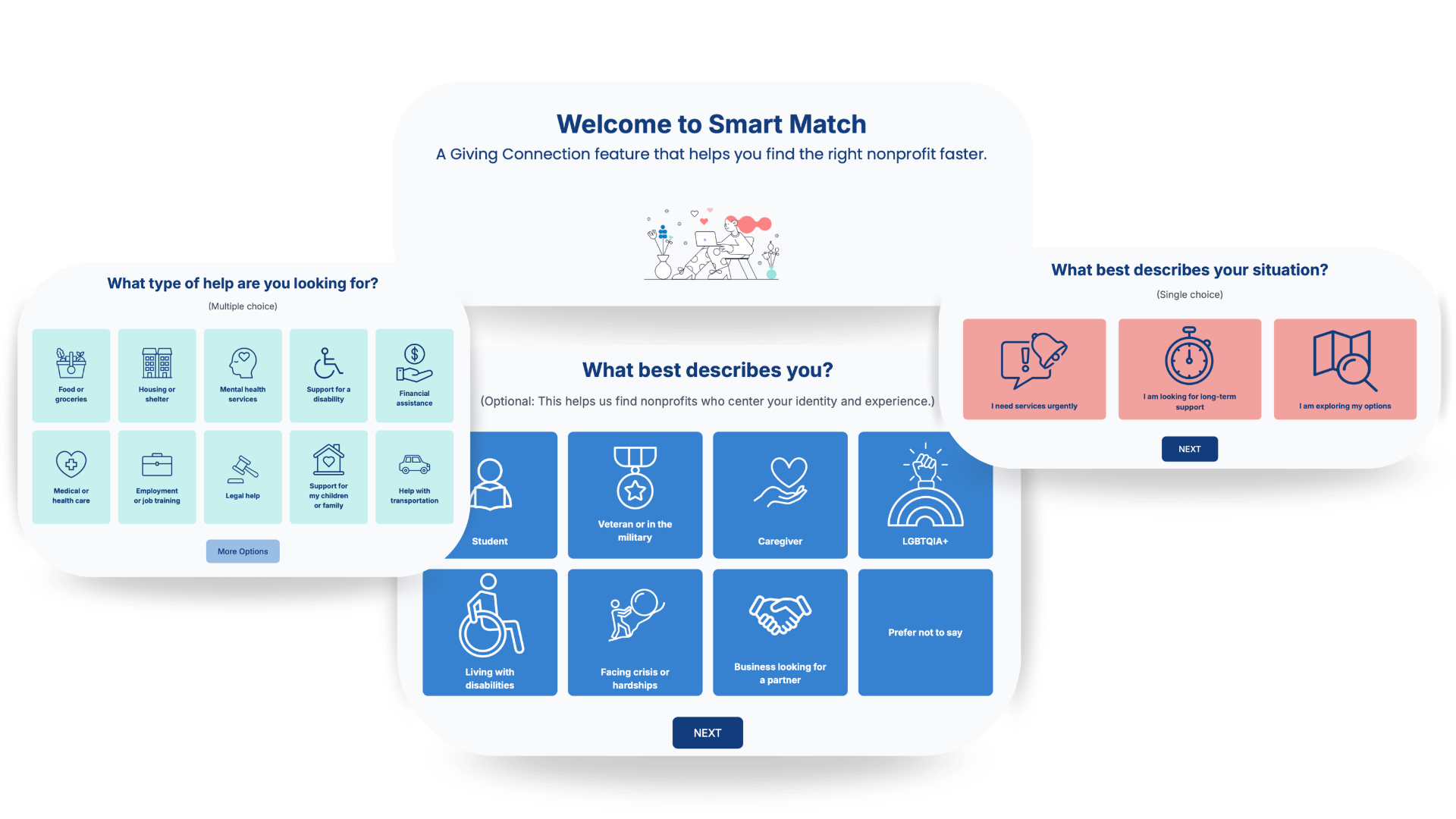
Designed and coded the quiz experience, built interactive prototypes, and iterated on UI clarity and match relevance end-to-end.
The Solution
The Smart Match Engine introduces:
A lightweight branching quiz that helps users articulate their needs
ML-powered semantic matching instead of keyword search
Personalized recommendations with high clarity and low friction
Reduced overwhelm for users seeking help in stressful moments
A scalable matching foundation for Giving Connection's future features
Learnings
What I took away
Design clarity shapes user confidence.
Building Smart Match taught me that people make better decisions when the product removes friction from their thinking. Clearer questions, guided flows, and simple visual cues didn't just improve usability, they made users feel more certain, capable, and supported during moments of stress.
The model only works when the system works.
I learned that a matching engine isn't defined by its embeddings alone, but by how the entire system works together: the quiz, the logic, the UI, and the expectations. Real impact came from aligning the ML, the experience, and the user's mental model into one coherent flow.