01 Scan
Reads your skin against your own baseline
The scanner reads moisture and sebum where it touches the skin while a camera captures the whole face. Every reading is compared with your own earlier sessions.
Nura · Project
Nura scans your skin before each session, adds signals like sleep and stress if you opt in, and layers a fresh dose from eight sealed active cartridges and two bases. I designed it end to end, from 100+ interviews through industrial design, the companion app, and the computer vision that measures skin in 3D.
Skin changes with seasons, stress, your cycle, travel, and sleep, but traditional skincare commits to one formula before it ever reaches you. Nura keeps its components separate, so what you put on your skin can change when your skin does.
Today the computer vision runs end to end on real captures, and the device is designed through industrial design, mechanical layout, schematics, and a preliminary bill of materials. A working prototype comes next.
The scanner reads moisture and sebum where it touches the skin while a camera captures the whole face. Every reading is compared with your own earlier sessions.
Sleep, stress, and cycle from HealthKit, plus UV index, air quality, and humidity where you are. They are context for the recommendation, with no medical inference drawn from them.
The recommendation picks from eight sealed active cartridges and sets how much of each. Firmware holds every amount under a fixed ceiling, routes actives by time of day, and blocks allergens and expired cartridges.
A serum or moisturizer base goes into the bowl first, then each active in order from one shared ceramic piston. A scale under the bowl checks the weight against the plan. Scan to skin takes about 90 seconds.
User and expert interviews defined the requirements, user flows, and interaction design for the device UI and app.
I led the industrial design, mechanical architecture, schematics, and preliminary bill of materials for the device and its cartridge system.
I designed and built the app, from UX flows to UI and design system, personalizing routines from HealthKit biomarkers (sleep, stress, HRV), environmental data, and skin scans.
I built the vision pipeline: structure from motion, a ~1M-primitive 3D reconstruction, a canonical skin map, and five skin layers measured against your own baseline.
The sensing and the dispensing sit in one object. Fixed illumination and a fixed focal distance make each session comparable with the last, and the formula can change the same day the skin does.
Eight sealed, syringe-style cartridges sit in a Geneva-indexed rotary drum driven by a stepper. One ceramic piston, shared across all eight positions, dispenses whichever cartridge is at the station. A second ceramic piston with a selector valve draws from two collapsing bag-in-box pouches, a serum and a moisturizer.
There is no mixing chamber and no shared standing fluid path. The base goes into the bowl first, then each active in an order the firmware sets for compatibility, and the user blends with their fingertips, the way people already layer serums.
| Option | Assessment | Decision |
|---|---|---|
| Ceramic piston | Seal-less, handles roughly 100 to 50,000 cP without shearing emulsions, about ±1% over 100M+ cycles, stepper-driven at 35 to 45 dB. | Selected |
| Gear pump | Shears emulsions, so it can't handle cream or serum viscosities. | Excluded |
| Peristaltic | Tubing fails within roughly 500 to 2,000 hours, so it would need several replacements over five years. | Excluded |
| Solenoid or diaphragm | Limited to around 1,000 cP, too thin for the moisturizer base. | Excluded |
| Pneumatic | Compressor noise rules it out for a bathroom counter. | Excluded |
Twice-daily use adds up to about 22,000 cycles over the device's life, against 100M+ documented cycles for the pump class.
The piston encoder records plunger travel per actuation, so firmware knows what is left in every slot. The app warns at 20% and prompts a reorder around day 28.
Sealed single-use cartridges, pouches that never admit air, 50 to 100 µL of suckback at the end of each stroke, recessed nozzles, and keyed collars that only fit the right slot.
The wand carries macro optics, white and UV light behind a cross-polarized filter, and a capacitive moisture ring, over BLE. A full-face camera sits behind a physical shutter.
The aim is comparable measurement over time. Seven ordinary computer vision stages put every capture of a face into the same coordinate system, so two captures can be compared patch by patch. The pipeline runs end to end on real captures, locally, with nothing uploaded.
Redness, pigmentation, fine lines, under-eye, and texture, each in its own color space and spatial scale so shadows, highlights, and skin grain don't score. Each is read against the face's own median, so it holds across skin tones.
A generous multi-scale proposal on redness and darkness channels, then a small, strongly regularized model trained on human labels. Four classes: acne, post-acne mark, pore, and nothing. Pores are the hard case.
A local labeling tool works on the flat skin map or the 3D reconstruction, since a mark can be invisible on one and obvious on the other. Every reported number is out-of-fold under stratified cross-validation across seeds.
Moisture and sebum are read physically at the wand tip. What you see compares today with your own previous sessions, with no 0-to-100 skin score.
Machine learning lives only in the personalization layer. Dosing is deterministic and enforced in firmware, so the model recommends inside limits it cannot exceed, and a scale under the bowl checks every session.
| Failure mode | Mitigation |
|---|---|
| Wrong dose from the model | Deterministic rule engine, firmware ceilings, and a weight check every session. |
| Dose volume off specification | Dispense testing on a physical prototype before the bill of materials is frozen. |
| Allergy missed | A hard exclusion set at onboarding, with no override. |
| Wrong cartridge in a slot | Keyed collars, plus an identity check when a cartridge goes in. |
| Drips or clogs between sessions | Suckback, recessed tips, a parked platen, and accelerated cycling tests for every formulation class. |
| Actives degrading | Stabilized derivatives, opaque sleeves, and a 90-day firmware expiry. |
| Scan data exposure | On-device processing wherever possible, explicit consent, and a defined retention policy. |
Each mitigation is designed in and still needs validation on a physical prototype.
Before the countertop device, I built Nura for retail: an in-store diagnostic that scored skin with computer vision, read lifestyle factors, and generated a routine on the spot, plus a dashboard that turned those signals into insights for store teams.
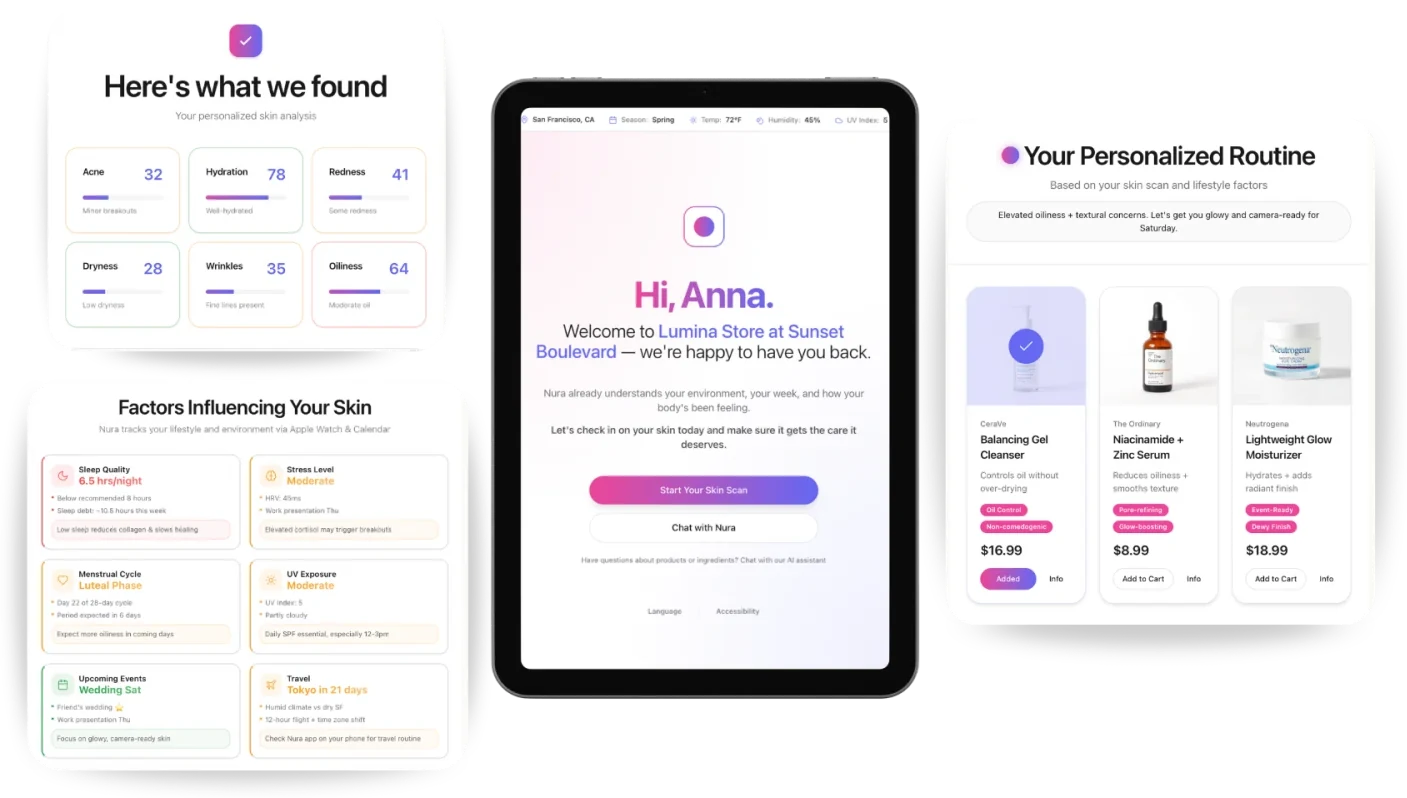

People trust a diagnostic when they feel guided and understood. Designing warmth and clarity into the flow mattered as much as model accuracy.
The best recommendations come from combining vision, lifestyle, environment, and behavior into one system. The intelligence emerges from how those pieces interact.
An earlier, better-looking score turned out to be reading a shortcut in a biased label set, so I discarded it. Several plausible features and one whole 3D layer were built, measured, and pulled when the data didn't support them.
The learning curve is still climbing as labels are added, while swapping the model class moves results less than seed-to-seed noise. More labeled positives help more than a bigger model.
Next project