All work

Renude · 2026

An AI beauty concierge that lives inside the shop.

The brief was a skin-analysis revamp. Research turned it into something larger. In ten weeks I researched, designed, engineered, and user-tested a concierge plugin for beauty retailers: 22 ways in from the storefront, a browser-side agent with 27 tools, and answers that show their work. I handed it to the team as a live prototype.

Role
AI Engineer & Product Intern
Timeline
Jul to Sep 2026 · 10 weeks
Research
3 expert interviews, 8 user tests, weekly team reviews
Stack
React 19, Vite, Tailwind, OpenAI Responses API, SSE, Vercel

How the brief moved

Renude makes skin consultation tools that beauty retailers install on their sites: a quiz with photo analysis, and a chat that recommends routines. Week one's brief was to revamp the analysis.

Auditing the live assistant on a retailer's site, screen by screen, showed the biggest losses weren't inside the analysis but around it. The tool was hard to find, mistaken for customer support, forgot the shopper between pages, and couldn't talk about the product on screen. By week four the question had become: where does AI enter the shopping journey, and how does it earn trust once it's there?

Research

Market

Seven products on one grid

Most beauty AI was hard to discover, quiz-heavy, and over-promised on intelligence. Few turned answers into anything a shopper could keep.

Journey audit

Every friction point, pinned

I used the live assistant end to end, marked where it broke or stalled, then watched testers think aloud through the same flow.

Interviews

Engineering, skin practice, science

They set the rules: reassure without overclaiming, explain the why in a warm sentence, and never infer a shade from a photo.

A store to test it in

Three weeks in Figma couldn't answer the real questions, which were about behavior over time: whether a self-typing ask bar reads as an invitation, or whether a panel that follows you across pages feels like a companion. So I built Solar, a fictional retailer with product pages, a bag, checkout, search, filters, and 72 products across skin, makeup, and hair, then installed the concierge on top of it. Testers could use each idea directly.

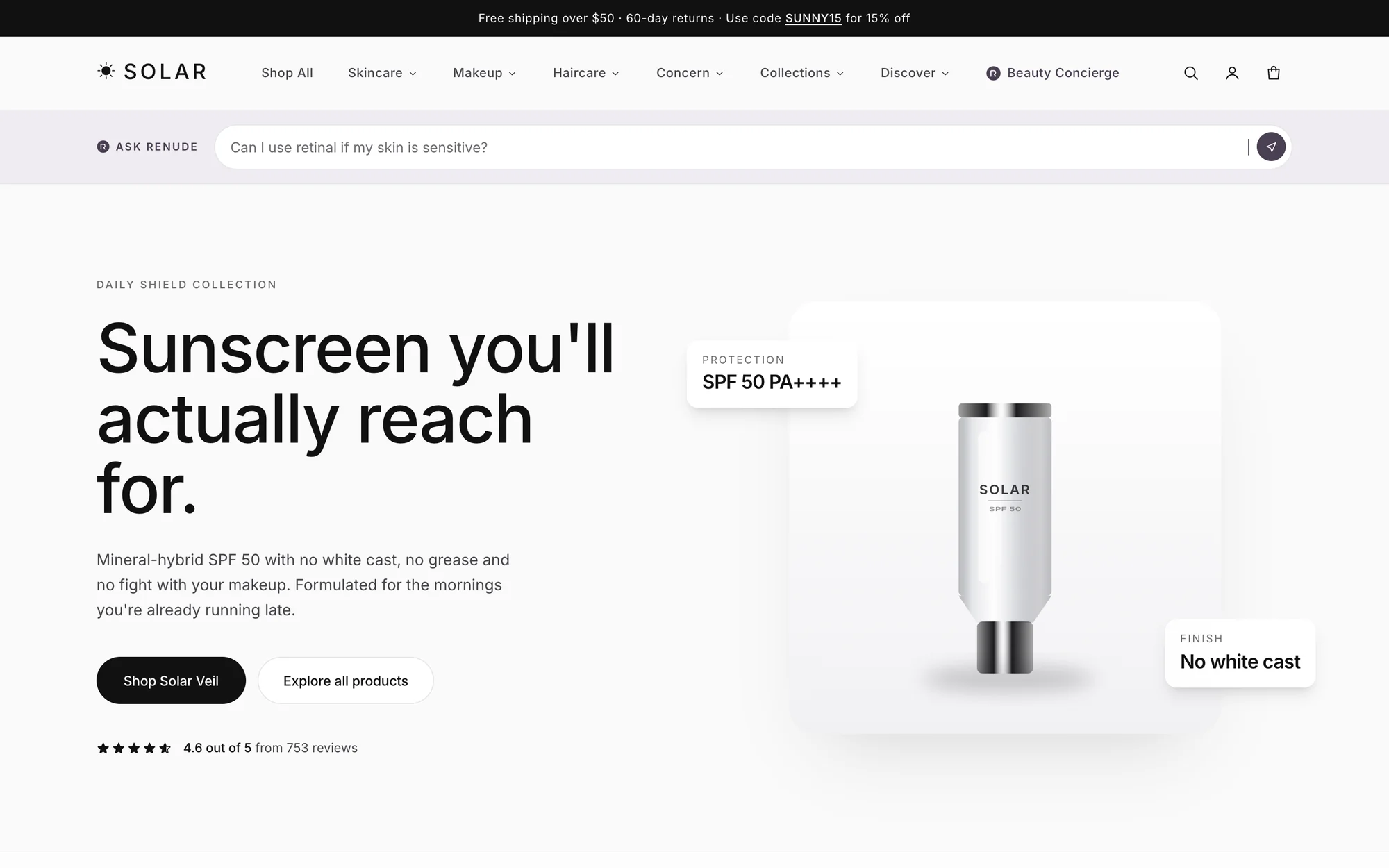
Solar's homepage, with an Ask Renude bar typing a question beneath the navigation, above the store's own sunscreen hero
The ask bar types its question character by character and sits above the store's hero. Every lower placement got scrolled past in testing.

Architecture

The concierge is a plugin layered on the host store. Only two adapter files touch the retailer, and retailer pages only know a named slot, the same contract as a Shopify theme app extension. Turned off, it leaves zero Renude strings in the page.

The agent runs in the browser: the model decides what the shopper meant and how to phrase it, while tools run against live state, so the profile and bag never leave the device. A stateless proxy holds the key, builds the system prompt server-side, validates input, rate-limits per IP, and streams the response back. Tool schemas are generated from the browser's own definitions at build time, so they can't drift.

StorefrontTwo adapter files and named slots
Agent loopIn the browser, 27 tools on live state
ProxyStateless; holds the key, streams SSE
Responses APIOrchestrates and phrases
CardsEmitted by tool runs, never parsed from prose
If a round trip fails, the harness retries once, then hands that answer to an offline intent router wired to the same 27 tools, and the panel says so.

Answers that show their work

Testers distrusted a tool that answered the same question two ways, and a retailer's own assistant starts out suspected of selling. So the model never states a fact it wasn't handed. Every price, ingredient, and verdict comes from a tool, and cards are drawn by tool runs. The profile reaches tools through a proxy that records which answers each run actually read, so "read from your profile" is measured from the run itself. With no profile saved, it says nothing about "your" skin.

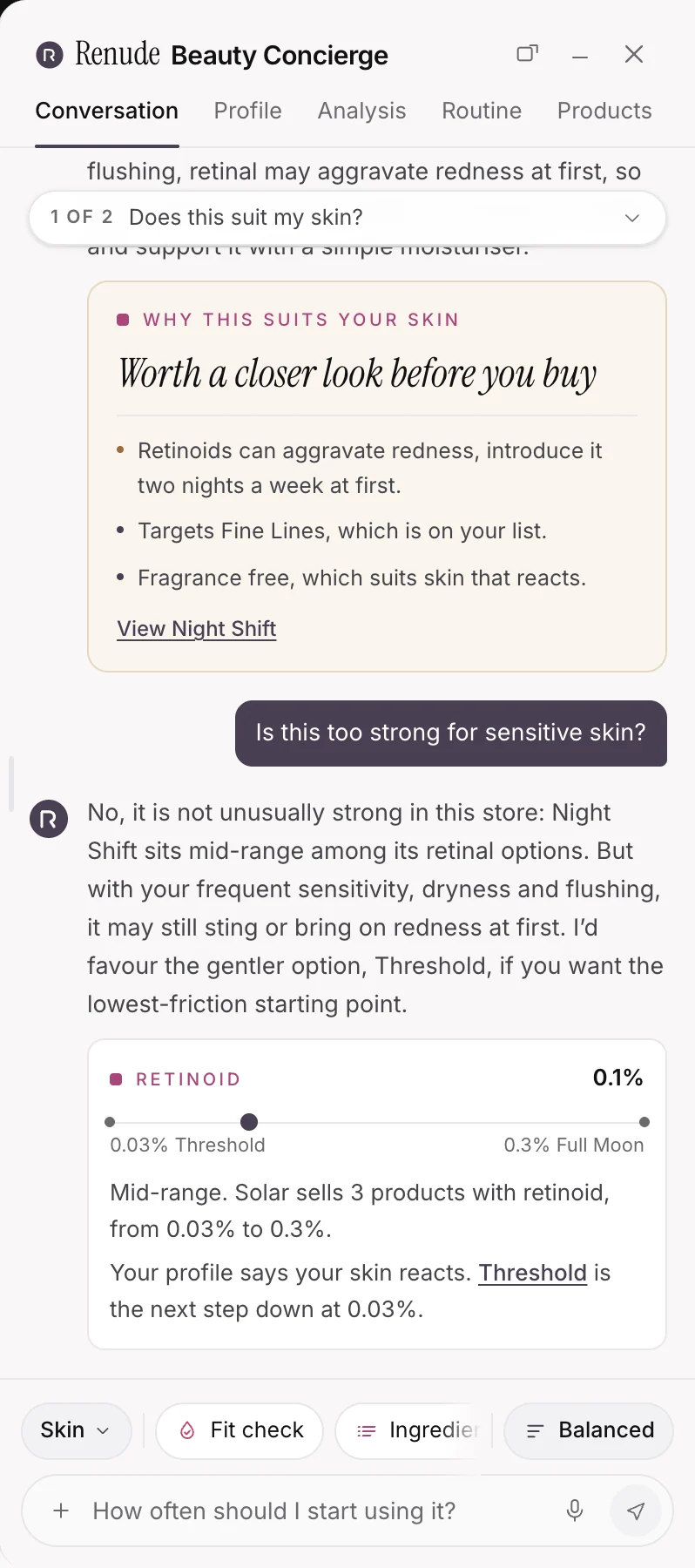
Concierge panel: after a fit check, the shopper asks if Night Shift is too strong for sensitive skin. A strength card places its 0.1% retinal between the store's 0.03% and 0.3% options and points to the gentler one.
Strength card. Where this concentration sits among what the store sells, and the next step down.
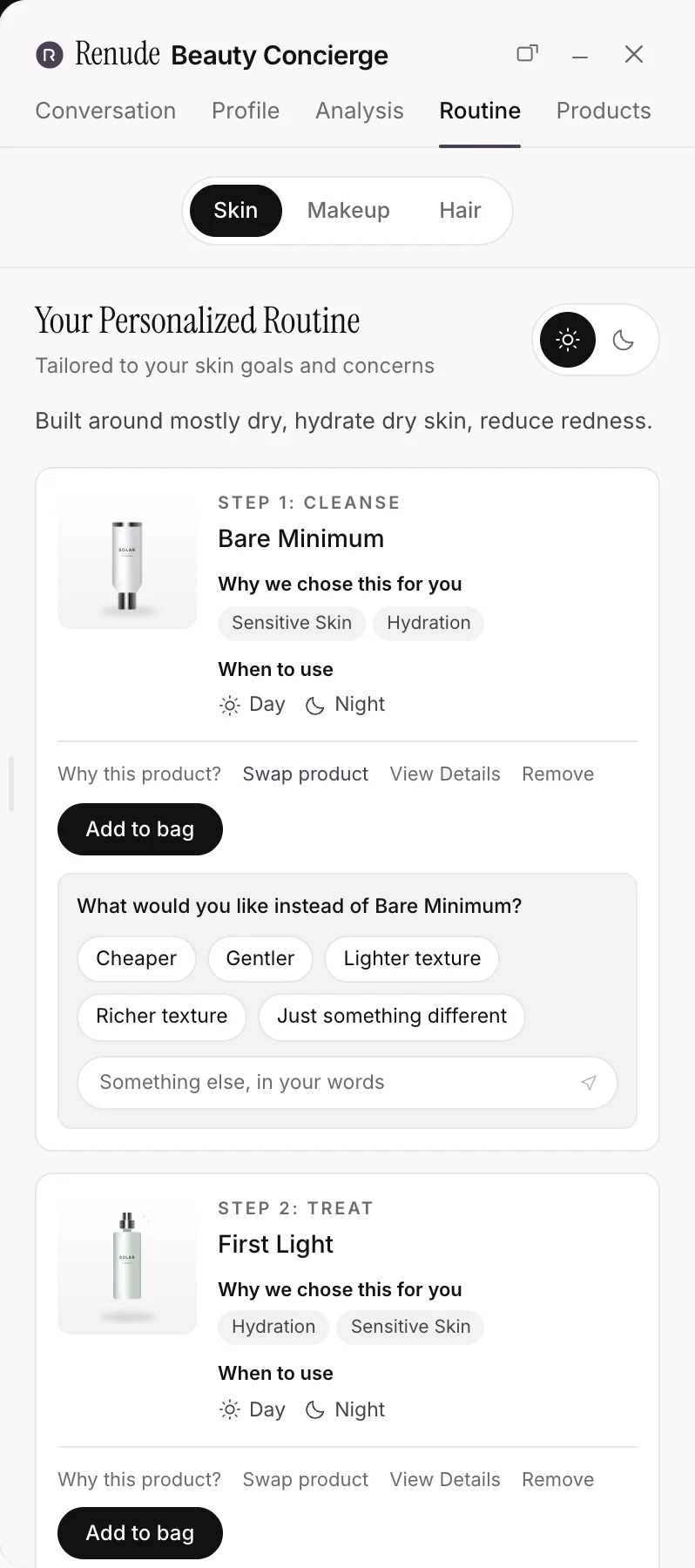
Routine tab with a day and night toggle. Under the cleanser, Swap product asks what the shopper wants instead: cheaper, gentler, lighter texture, richer texture, or something different.
Ask before acting. A swap asks what you want instead, then lands on the same card with Undo.
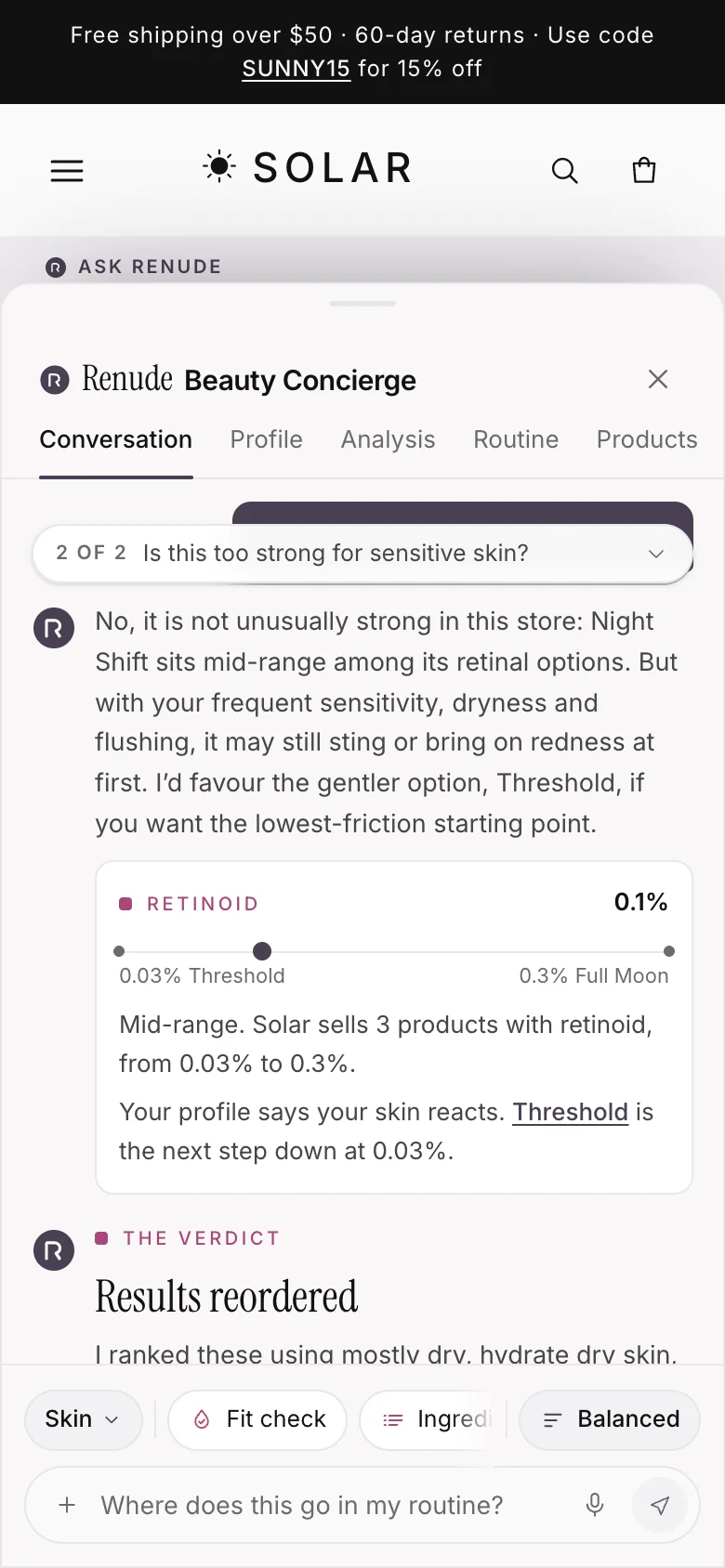
The same conversation on a phone, shown as a bottom sheet over the store, with the strength card and a thread anchor at the top
On phones. The same panel as a bottom sheet; the store stays usable behind it.

Feature by feature

Entry points

22 doors, each measured

An ask bar that types its own question, signal chips on product cards, a product-page question block, a search box that takes questions, a bag review. Each fires seen and clicked separately, because "nobody noticed it" and "nobody cared" need opposite fixes.

Personalized grid

The grid reorders itself

"Personalize these products" ranks the aisle against the shopper's profile. Cards glide to their new places, and the panel lists what moved down and why, so the shopper sees the tool doing the work.

Agent

Tools behind every answer

The model works out what the shopper meant and phrases the reply. Every fact comes from a tool run on live state: the product on screen, the saved profile, a compatibility check. The card is drawn by the tool, never parsed out of prose.

Follows you

It goes where you go

The conversation stays put while the shopper moves between aisles, and the skill rail follows them. The panel docks, floats as a window that can be dragged off the products, or folds down to its title bar. Testers asked for more room, and this is what came of it.

Skills

Named skills, real plans

Nine skills sit on a rail, and picking one fills the box while sending stays with the shopper. Occasion planning turns a beach wedding into one plan across skin, makeup and hair with the clashes flagged. A week in Lisbon becomes a carry-on edit from the saved routine.

Beyond skincare

Makeup and hair, too

Each vertical has its own short profile. Shade matching works from the undertone and depth the shopper states, never from a photo, and wash day builds on hair texture and what they are dealing with.

Consultation depth

Quick, Balanced, Full

One control changes the register of the answer and re-tiers every card already in the thread, without asking again.

Routine

Asks before it acts

A swap asks what the shopper wants instead: cheaper, gentler, a lighter or richer texture. Then it lands on the same card with the reason and an Undo.

Memory

Products, stamps, notes

Saved items, "not for me" stamps, and notes in the shopper's own words that the concierge reads back, synced to the retailer's wishlist through the adapter.

Voice

Dictation that works everywhere

Browser speech worked for one tester and hung for the next, so audio is transcribed on the server and lands in the box for review. It never sends on its own.

Review summaries

Two phases that can't disagree

Stats are computed first and prose is written over them; the merge step rejects any prose containing a digit. Generated once, stored, and read, never inferred at page view.

What testing changed

  • Structured answers read as honest. The same recommendation as a card felt less like a sales pitch than as a paragraph, so cards replaced prose everywhere.
  • Corner bubbles got ignored as promo-code widgets and pop-ups got closed on instinct, so the launcher was quieted and the ask bar moved above the hero.
  • Features went unused until they had names. A skills menu behind a plus button was invisible; a rail of named skills became something testers came back for.
  • People wanted the panel bigger, which produced a resizable drawer, a movable window, and a draggable phone sheet.
  • Saving was the surprise. Nobody asked for it in the brief and every tester reached for it, which became the Products tab.

What I learned

Lead with a conclusion.

Entry points that offered to help were walked past. The ones that had already worked something out, like a chip saying "worth a closer look," got used.

Trust comes from provenance and consistency.

Testers believed an answer when they could see which of their own answers it used. Being traceable and predictable mattered more than being clever.

Depth lives in the vocabulary.

A quick answer and a full one differ in which words are used and what gets named. Once that was clear, one control replaced a set of persona ideas.

Motion should explain a change.

A grid that visibly reorders reads as the tool having done something. A fake "analyzing" pause reads as theater.